
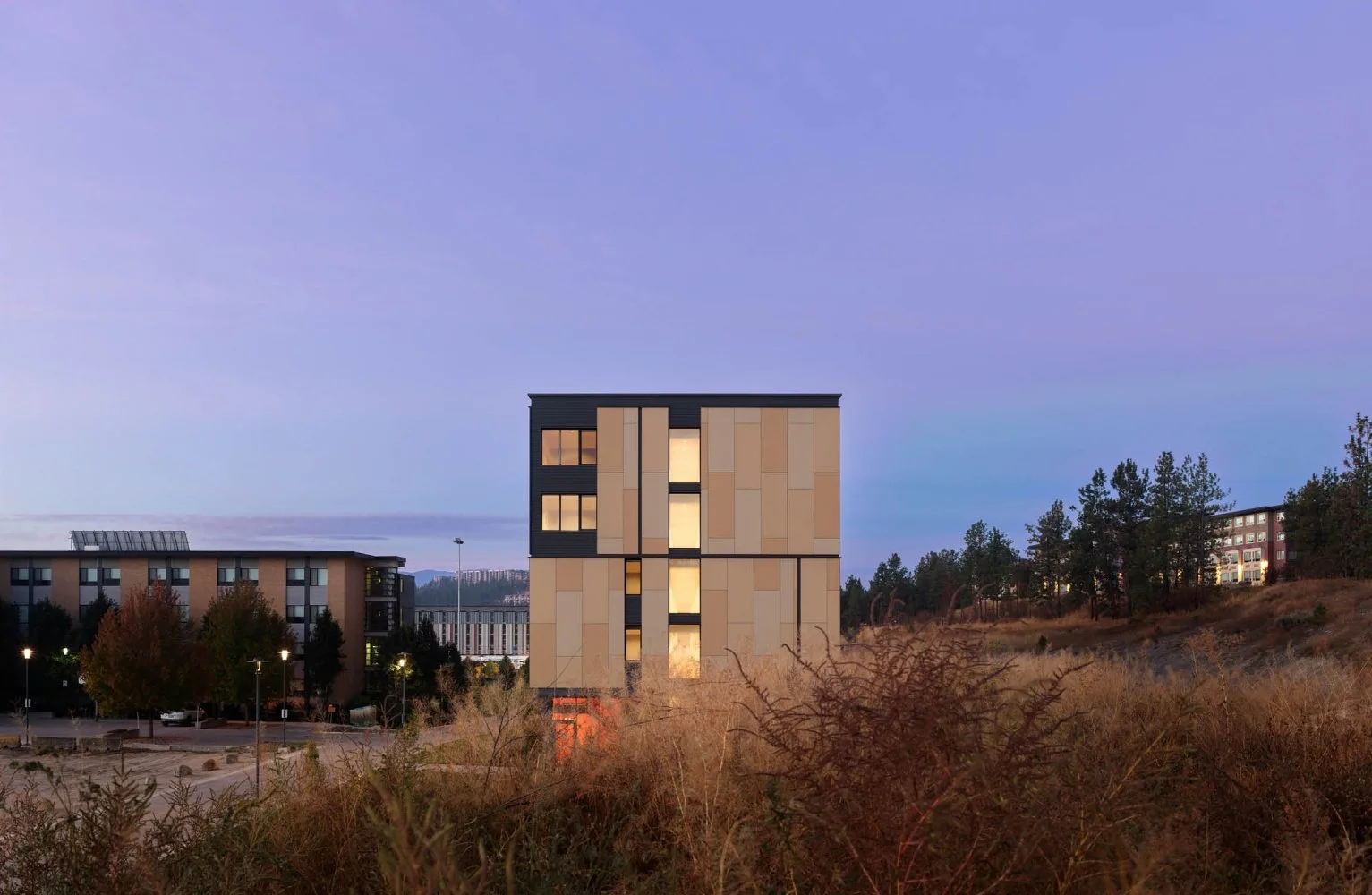
Skeena Residence at the UBC Okanagan campus, by Public Architecture, was the first Passive House-certified student residence in Canada.
Building energy performance, housing affordability and the economics of regulatory change
Estimated reading time: 7–9 minutes
In February 2025, Saskatchewan announced that it would reverse its recently introduced building energy-efficiency requirements, returning to Tier 1 of the 2020 National Building Code of Canada. The decision came little more than a year after the province had implemented Tier 2 and committed to progressing towards Tier 3.
Meanwhile, British Columbia has continued to operate under one of Canada's more ambitious building energy-performance frameworks, with the BC Energy Step Code influencing architectural design, construction methodology, building envelope specifications and development economics across the province.
The divergence between these two jurisdictions raises questions that extend beyond energy conservation. At a time when governments are simultaneously pursuing housing affordability, construction productivity and climate objectives, Saskatchewan's experience provides an opportunity to examine how these competing priorities are being reconciled through building regulation.
Saskatchewan: A Change in Direction
Perhaps the most noteworthy aspect of Saskatchewan's policy reversal is that it occurred under the same government that introduced the higher standards. The Saskatchewan Party, led by Premier Scott Moe, remained in office throughout the adoption, postponement and subsequent reversal of the requirements.
The chronology illustrates how rapidly the province's regulatory direction changed.
December 2023 — Adoption of higher energy standards
Saskatchewan announced the adoption of the 2020 national construction codes, establishing a phased approach towards higher energy-performance requirements for housing and small buildings.
January 2024 — Tier 2 becomes mandatory
The province implemented Tier 2 of the National Building Code's energy-efficiency framework, with Tier 3 initially scheduled for January 2025.
September 2024 — Implementation postponed
Following concerns regarding construction costs and industry readiness, the government deferred Tier 3 implementation until January 2026.
October 2024 — Provincial election
The Saskatchewan Party was returned to government. Although the subsequent regulatory reversal occurred shortly after the election, the timing alone does not establish a causal relationship.
February 2025 — Return to Tier 1 announced
The government announced that it would return to Tier 1, citing housing affordability, industry feedback and regulatory harmonization with Alberta and Manitoba.
April 2025 — Legislative scrutiny and regulatory amendment
The decision was examined during proceedings of the Standing Committee on Intergovernmental Affairs and Justice. Saskatchewan Regulation 31/2025 subsequently formalized the return to Tier 1.
Higher energy-performance tiers remain available to owners and builders on a voluntary basis.
Behind the Policy Reversal
The April 1, 2025, proceedings of Saskatchewan's Standing Committee on Intergovernmental Affairs and Justice offer a particularly useful insight into the considerations behind the government's decision.
Representatives of the homebuilding, real estate and rental housing sectors had expressed concerns regarding the additional capital costs associated with progressing through the energy tiers. During the committee proceedings, potential incremental costs of up to $15,000 per dwelling for moving from Tier 1 to Tier 3 were discussed.
The province also withdrew from the federal Codes Acceleration Fund, through which approximately $3 million had been allocated to support accelerated energy-code implementation, industry training, technical capacity and research.
Of particular interest was the acknowledgement by provincial officials that their planned quantitative cost analysis had not been completed before the decision was made.
Opposition NDP MLA Jared Clarke questioned whether sufficient consideration had been given to lifecycle energy savings, referencing potential annual savings of approximately $620 per household. The government's position emphasized consumer choice, upfront affordability and alignment with neighbouring provinces.
Neither the construction premium nor the annual energy savings cited during the proceedings should be interpreted as universally applicable figures. Both depend on building typology, climate, construction methodology, energy prices and the baseline against which improvements are measured.
The legislative discussion nevertheless provides a useful illustration of the competing economic considerations informing energy-code policy.
British Columbia: A Different Regulatory Trajectory
British Columbia introduced the Energy Step Code in 2017, establishing a performance-based regulatory framework supported by a progressively increasing set of energy targets. Initially available for voluntary adoption by local governments, the framework subsequently became part of the mandatory provincial building code requirements in May 2023.
The original trajectory envisaged most new construction reaching net-zero energy-ready performance by 2032.
Unlike Saskatchewan, where the national tiered framework had been in mandatory operation at Tier 2 for approximately one year, British Columbia has spent several years developing the professional expertise, manufacturing capacity and construction practices required to support higher-performance buildings.
Energy modelling, thermal-bridge analysis, enclosure commissioning and airtightness verification have consequently become increasingly embedded within architectural practice.
Comparing the two regulatory frameworks
| Parameter | Saskatchewan | British Columbia |
|---|---|---|
| Regulatory framework | National tiered energy codes | BC Energy Step Code |
| Part 9 minimum standard | NBC Tier 1 | Step 3 for most applicable buildings |
| Larger buildings | NECB Tier 1 | Step 2 for most applicable Part 3 buildings |
| Higher performance standards | Voluntary | May be required locally |
| Regulatory direction | Return to baseline requirements | Progressive increases, subject to policy review |
| Original net-zero-ready target | No equivalent mandatory commitment identified | 2032 |
The national tiers and BC's steps are not directly interchangeable. Although both establish progressively higher levels of energy performance, their calculation methodologies, technical metrics and reference-building assumptions differ.
Vancouver also operates under its own Building By-law, introducing another layer of regulatory variation within British Columbia itself.
Is British Columbia Reconsidering Its Approach?
The Saskatchewan decision becomes particularly relevant in light of the Independent CleanBC Review published in November 2025.
The review examined the province's climate policies within the broader context of affordability, economic competitiveness and emissions reduction. Its recommendations included several significant departures from the original Energy Step Code implementation strategy:
· Eliminating the highest energy-performance steps—Step 5 for Part 9 and Step 4 for Part 3 buildings—based on the relationship between additional expenditure and anticipated benefits.
· Deferring the next mandatory provincial increases from 2027 to 2030.
· Introducing greater regional differentiation in the application of the Zero Carbon Step Code.
· Retaining municipal authority to advance beyond provincial minimum requirements while encouraging regional coordination.
The Urban Development Institute has separately advocated maintaining existing provincial energy-performance minimums and restricting municipalities from imposing more stringent requirements.
In May 2026, BC's Ministry of Housing and Municipal Affairs indicated that it was undertaking further assessment of the costs and impacts of both Step Codes. The assessment was expected in early autumn 2026.
These developments represent different policy positions and recommendations rather than necessarily enacted amendments to the Building Code.
The Economics of Energy Performance
One of the complexities of evaluating energy-efficiency regulation is that construction expenditure and long-term financial benefits often accrue to different parties.
In a conventional condominium development, the developer absorbs the additional capital expenditure associated with higher-performing building assemblies, while purchasers receive the subsequent operational savings. In purpose-built rental housing, the distribution of these benefits depends on ownership horizons, utility metering arrangements and operating expenditure structures.
The relationship between construction cost and housing affordability is therefore not necessarily linear.
British Columbia's 2022 Energy Step Code metrics research, referenced in the provincial Step Codes Guidebook, provides an indication of the modelled incremental construction costs associated with higher standards.
| Building typology | Performance target | Modelled cost increase over Step 1 |
|---|---|---|
| Medium single-family house | Step 3 | 1.1–1.2% |
| Medium single-family house | Step 5 | 2.9–3.1% |
| Rowhouse | Step 3 | 0.6–0.7% |
| Multifamily residential | Step 3 | 0.4–0.9% |
These figures represent historical modelling scenarios rather than contemporary tender results. The multifamily estimates also reflect selected cost-optimized scenarios in particular climate zones.
For practitioners, the distinction between the theoretical cost of achieving a performance target and the actual cost of delivering it within a constrained development envelope is particularly important.
A building optimized exclusively for thermal performance may differ considerably from one responding simultaneously to municipal urban design requirements, market expectations, structural constraints, unit planning efficiency and development economics.
Implications for Architectural Practice
Architectural expression and thermal performance
The consequences of increasingly stringent thermal targets are rarely confined to mechanical specifications or additional insulation.
Building morphology, glazing ratios, façade articulation, balcony configuration and structural penetrations all influence thermal energy demand. Architectural decisions established during rezoning can effectively determine the cost and complexity of achieving subsequent energy-performance requirements.
Where municipal urban design objectives encourage slender floorplates, substantial façade articulation or extensive glazing, the resulting increase in enclosure area and thermal bridging may introduce additional compliance challenges.
The interaction between planning policy and building energy regulation consequently deserves consideration beyond the individual requirements of either framework.
Diminishing marginal returns
Moving between successive energy-performance thresholds does not necessarily produce a proportionate relationship between investment and savings.
Once relatively economical improvements to airtightness, insulation continuity and heat recovery have been implemented, further reductions in energy demand may require substantially different glazing systems, structural connections or enclosure assemblies.
Conversely, improvements to components with long replacement cycles may avoid significant future retrofit expenditure.
Evaluating these investments requires consideration of service life, maintenance obligations, equipment replacement cycles, energy-price assumptions and operational carbon intensity.
Professional services and regulatory complexity
Performance-based compliance has expanded the scope of interdisciplinary coordination within architectural practice.
Energy models must remain aligned with enclosure details, mechanical-system selection, glazing procurement and construction substitutions. Changes made during tendering or construction can affect assumptions established considerably earlier in the design process.
This introduces questions regarding professional fees, consultant responsibilities, construction-stage verification and the allocation of liability when as-built performance differs from design-stage predictions.
The financial implications of energy regulation therefore extend beyond construction materials and equipment to the professional services required to demonstrate compliance.
Regulatory certainty and supply-chain investment
British Columbia's existing regulatory trajectory has supported investment in high-performance glazing manufacturing, thermal-break technologies, ventilation equipment, prefabricated enclosure systems and specialized consulting services.
Manufacturers and construction professionals make investment decisions partly in response to anticipated future regulatory requirements.
Saskatchewan's reversal illustrates another dimension of energy-code policy: the relationship between regulatory certainty and industry investment. Changes in either direction can affect manufacturing demand, workforce training and procurement strategies established around previously announced standards.
Climate, Geography and Regulatory Harmonization
A direct comparison between British Columbia and Saskatchewan also requires consideration of regional differences.
Saskatchewan's predominantly continental climate presents substantially different heating requirements from coastal British Columbia. Northern and interior BC, however, experience climatic conditions considerably different from those of Metro Vancouver.
Regional variations include:
· Heating and cooling degree days.
· Electricity and natural gas prices.
· Electrical grid carbon intensity.
· Availability of specialized construction labour.
· Local manufacturing and distribution capacity.
Energy efficiency and operational carbon reduction are related but distinct objectives. A building with lower energy consumption does not necessarily achieve an equivalent reduction in greenhouse gas emissions across jurisdictions with different electricity-generation profiles.
Saskatchewan's emphasis on harmonization with Alberta and Manitoba raises a broader question regarding whether nationally consistent compliance methodologies could coexist with regionally differentiated performance targets.
For architectural practices operating across Canada, differences in modelling protocols, documentation requirements and regulatory interpretations can introduce additional costs even where the intended performance outcomes are comparable.
Questions for the Profession
As British Columbia considers the future direction of its energy regulations, Saskatchewan's experience raises several questions worthy of further examination:
· How should governments balance initial housing affordability against lifecycle operating expenditure?
· At what point do incremental improvements in building energy performance become economically disproportionate?
· Should energy-efficiency thresholds reflect regional construction economics and climate conditions more explicitly?
· How should municipal urban design requirements be reconciled with increasingly stringent thermal-performance objectives?
· Would greater alignment with national energy codes reduce professional and regulatory complexity?
· How should changes to previously announced performance targets account for investments already made by manufacturers and construction professionals?
· What post-occupancy performance data should inform future regulatory amendments?
· Should the cumulative impact of energy, accessibility, sustainability and other building regulations be evaluated collectively rather than independently?
References and further reading
1. Government of Saskatchewan — Adoption of 2020 National Construction Codes, December 2023
2. Saskatchewan Association of Rural Municipalities — Energy Code Requirement and Ministerial Response
3. Government of Saskatchewan — February 2025 announcement
4. Legislative Assembly of Saskatchewan — Standing Committee Proceedings, April 1, 2025
5. Saskatchewan Gazette — Regulation 31/2025
6. Government of British Columbia — Energy and Zero Carbon Step Codes Guidebook
7. Independent CleanBC Review — Final Report, November 2025
8. Urban Development Institute — Provincial CleanBC Review and Step Codes, June 2026