
Beyond Mortgage Insurance: Why CMHC's Prefab Plus Initiative Matters to Architects
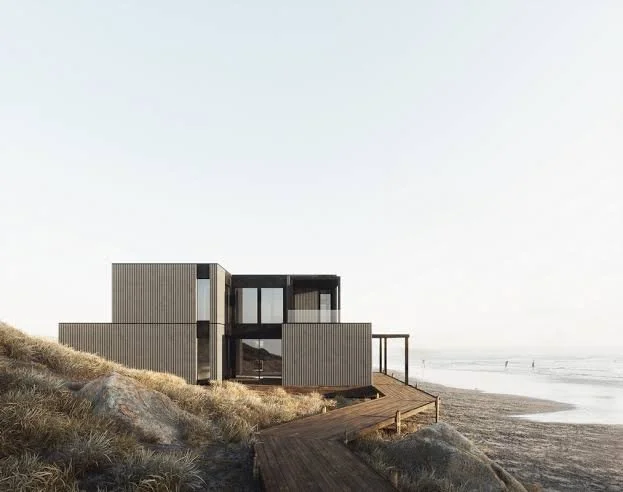
McKinley Studio’s ‘Commonplace’ prefabricated housing initiative.
At first glance, CMHC's expansion of mortgage insurance support for prefabricated and modular housing appears to be a financing initiative. In reality, it represents something much more consequential: an attempt to reshape Canada's housing delivery model.
For decades, the Canadian construction industry has struggled with stagnant productivity. While virtually every manufacturing sector has embraced industrialization, construction remains largely site-based, sequential, labour-intensive, and highly susceptible to weather, labour shortages, and quality variability. Despite advances in digital design, most buildings are still assembled much as they were decades ago.
Prefab Plus should therefore be viewed less as a housing finance program and more as industrial policy. By removing financing friction associated with factory-built housing, CMHC is signalling that industrialized construction is no longer a niche delivery method but a strategic component of Canada's long-term housing supply.
Financing Has Been the Missing Piece
The technical viability of modular construction has never been the principal obstacle to wider adoption.
Architects have successfully delivered modular hotels, student residences, supportive housing, healthcare facilities, and increasingly sophisticated multi-family developments for many years. The limiting factors have instead been financial and contractual.
Traditional construction lending evolved around site-built projects. Draw schedules assume that value is progressively created on-site through excavation, structure, enclosure, and interior fit-out. Factory-built projects invert this sequence. A significant proportion of project value is created months before components arrive on site, requiring substantial capital commitments to manufacturers well in advance of conventional construction milestones.
This mismatch has often increased financing costs, introduced lender uncertainty, and discouraged otherwise viable modular solutions.
CMHC's expanded insurance products begin to address this structural disconnect by recognizing factory production as legitimate construction progress rather than treating it as an exception. While seemingly administrative, this change could materially improve lender confidence and developer willingness to evaluate industrialized delivery systems.
A Procurement Shift Rather Than a Construction Shift
The most significant implication for architects is unlikely to be an increase in modular projects alone.
Instead, we should expect procurement models themselves to evolve.
Factory-based construction requires decisions that conventional procurement has historically deferred. Building systems cannot remain partially unresolved while shop drawings are developed or field coordination occurs. Manufacturing depends upon dimensional certainty, component standardization, and an exceptionally high level of interdisciplinary coordination before production begins.
Consequently, architects may find themselves participating much earlier in project definition, manufacturing coordination, and supply chain integration than under traditional delivery models.
The profession's value increasingly shifts from producing construction documents toward orchestrating information.
Designing for Manufacturing
Many architects continue to think about prefabrication primarily as modular boxes.
That perspective is increasingly outdated.
Modern industrialized construction encompasses a spectrum of manufacturing strategies including volumetric modules, panelized systems, prefabricated structural assemblies, bathroom pods, mechanical racks, facade units, utility corridors, and fully integrated building components.
Each carries different architectural implications.
Volumetric construction demands rigorous control over transportation geometry, craning sequences, cumulative tolerances, and module interface detailing.
Panelized systems offer greater planning flexibility but require careful consideration of sequencing, weatherproofing strategy, connection detailing, and manufacturing tolerances.
Pod-based construction transfers an increasing portion of coordination responsibility from subcontractors to the design team during early project phases.
In each case, architectural detailing increasingly resembles product design rather than conventional building assembly.
The Architect's Role Is Expanding
One of the unintended consequences of industrialized construction is the expansion—not reduction—of architectural responsibility.
As manufacturing moves off-site, many coordination activities previously resolved through field improvisation must instead be resolved digitally before production begins.
Architects are increasingly expected to understand:
Design for Manufacturing and Assembly (DfMA)
Digital fabrication workflows
Manufacturing tolerances
Logistics planning
Transportation constraints
Supply chain integration
Factory quality assurance processes
The profession therefore moves further upstream within the project lifecycle.
Rather than documenting construction, architects become integrators of manufacturing systems.
Implications for British Columbia
British Columbia occupies an advantageous position within this transition.
The province already possesses significant expertise in mass timber manufacturing, digital design, prefabricated building systems, and modular housing. Companies have demonstrated internationally competitive capabilities in volumetric modular construction, panelized timber systems, prefabricated building envelopes, and hybrid structural solutions.
Federal financing support may therefore reinforce existing provincial strengths rather than create entirely new markets.
For firms already delivering rental housing, institutional work, Indigenous housing, hotels, and mid-rise residential developments, industrialized construction may increasingly become a commercial expectation rather than a specialist offering.
Where the Greatest Opportunities May Lie
While modular apartment buildings often receive the greatest public attention, the largest opportunities may emerge elsewhere.
Hotels, student residences, seniors housing, supportive housing, workforce accommodation, and purpose-built rental projects all exhibit characteristics favourable to manufacturing-based delivery:
High unit repetition
Standardized room layouts
Predictable service coordination
Accelerated occupancy requirements
Strong schedule sensitivity
These building types also align closely with federal and provincial housing priorities, making them natural candidates for programs such as Prefab Plus.
Looking Ahead
CMHC's announcement is unlikely to transform the industry overnight.
However, it represents another incremental step toward an industrialized housing ecosystem in which financing, regulation, manufacturing, and design begin to align around factory production rather than traditional site construction.
For architects, the competitive advantage will not lie simply in understanding modular construction. It will lie in understanding manufacturing itself.
The firms best positioned over the coming decade will be those capable of integrating design excellence with production efficiency, digital coordination, procurement strategy, and industrialized delivery. As construction increasingly becomes a manufacturing process, architecture will increasingly become the discipline that connects design intent with industrial execution.